








A glossary of the trade
The vocabulary on a machine quote is not obvious from outside the trade, and buying the wrong thing usually starts with a word nobody stopped to define. These are the ones that come up.
Aquafall
Girbau's cascade wash system. Rather than drawing fresh water for every phase, it recirculates and cascades it through the load, which Girbau puts at up to 59% less water a cycle. Relevant wherever municipal tariffs or scarcity are part of the operating cost rather than an afterthought.
Barrier washer
A washer-extractor with two doors on opposite sides of the drum, also called a pass-through machine. Soiled linen is loaded on the contaminated side and clean linen comes out in a separate room, so the two never cross. The equipment prerequisite for an RABC-compliant laundry.
Buck
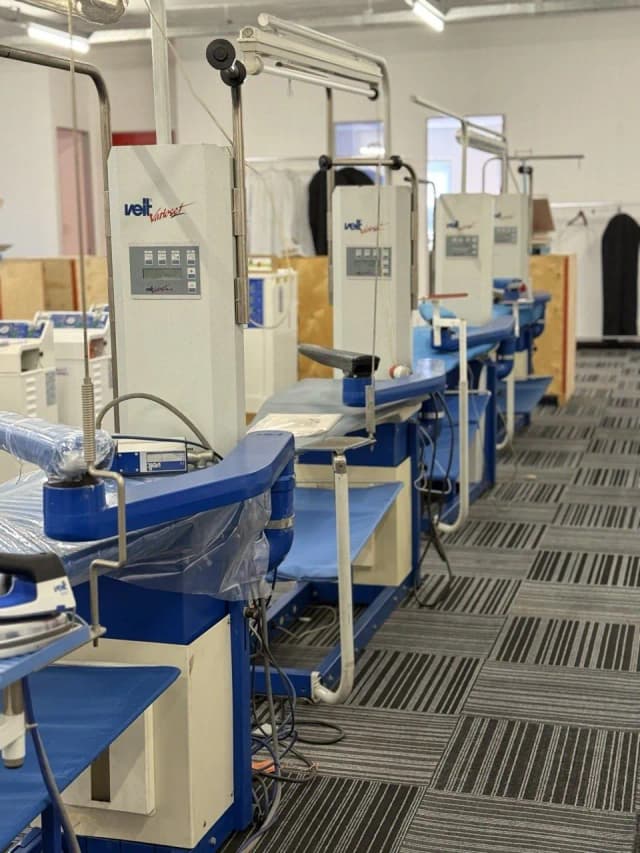
The fixed lower bed of a press, against which the head closes. Its shape is what the garment takes, which is why a jacket buck and a trouser buck are different machines rather than one machine with a setting.
Calender
A heated roller ironer for flatwork: sheets, tablecloths, pillowcases. The linen passes between a heated cylinder and a padded roller and comes out pressed and folded in one motion. Sized in metres of roll width, not kilograms.
Extraction
The spin at the end of a wash cycle, and the number that pays for itself. Every percentage point of water removed mechanically is drying time and electricity not spent afterwards. Measured in G-force.
Form finisher
A pressing machine with an inflatable body form. The garment is dressed onto it, then steam and hot air are blown through from the inside, so the fabric is finished without a soleplate touching it. What a shirt finisher and a jacket topper both are.
Fusing
Bonding an interlining to a fabric panel with heat and pressure — collars, cuffs and jacket front panels. A continuous fusing press runs the panels through on a belt at a controlled temperature and dwell, which is what makes the bond permanent rather than merely stuck.
G-force
The extraction speed of a washer-extractor, expressed as multiples of gravity rather than rpm, because rpm means different things at different drum diameters. A hardmount machine runs to about 200G; a softmount to 400G or more.
Gravity-feed iron
A professional iron fed from a water bottle mounted above it, so it needs no boiler and no plumbing. The bottle is where the name comes from. Suited to a single station; a multi-station floor wants a steam generator instead.
Hardmount
A washer-extractor bolted to a reinforced concrete slab. Cheaper to install because there is no suspension system, and limited to about 200G extraction because the vibration goes into the building. Ground floor only.
HORECA
Hotels, restaurants and catering, taken together as one buying sector. Common shorthand in European equipment catalogues and used the same way here.
Hydrocarbon
A class of dry cleaning solvent — DF-2000, EcoSolv, PureDry and others — used as an alternative to perchloroethylene. Gentler on fabric and non- chlorinated, at the cost of longer cycle times.
Kg steam per hour
How a steam generator's output is rated. It is the figure to size a finishing floor against, because pressing stations consume steam continuously rather than in the bursts a kW rating suggests. Undersizing here starves everything downstream at the moment the floor is busiest.
Multisolvent
A dry cleaning machine built to run more than one solvent class, so an operator can change what they clean with without changing the machine. BÖWE's Multisolvent line runs chlorine-free class A III solvents including hydrocarbon, K4, SENSENE, Higlo and GreenEarth.
OPL
On-premise laundry: a business processing its own linen on its own site rather than sending it out. Hotels, lodges, hospitals and mining camps typically reach the volume where it pays. Most of what this site sells is OPL equipment.
Offpressing
Final pressing after a garment is assembled, for retail-ready presentation. The counterpart of underpressing, and the only one a dry cleaner is usually doing.
Perc
Perchloroethylene, or PCE — the traditional dry cleaning solvent. Effective and fast, and being phased out in several jurisdictions on health and environmental grounds. There is no equivalent national ban in South Africa, but the global direction of travel is why multisolvent and wet cleaning machines exist.
Placket
The reinforced strip down the front of a shirt, where the buttons and buttonholes sit. Also the slit at the sleeve cuff. Both are folded and pressed with dedicated equipment on a shirt line, because hand work there is slow and inconsistent.
RABC
Risk Analysis and Biocontamination Control, the standard set out in EN 14065. It requires documented control of biocontamination through a laundry process, and applies to any laundry handling medical textiles. A barrier washer is the equipment on which the documentation stands.
Softmount
A washer-extractor suspended on springs or hydraulics, so it needs no floor anchoring and can go upstairs or into a converted building. Higher capital cost, and extraction to 400G or more because the suspension absorbs what a hardmount transfers into the slab.
Solvent
The fluid a dry cleaning machine cleans with instead of water. Which one a machine runs decides its ventilation, its recovery system and, increasingly, whether it can be sold at all. See perc, hydrocarbon, multisolvent and wet cleaning.
Spotting table
A workstation for treating stains individually before or after the main clean, with steam, vacuum, a compressed air gun and chemical dispensers to hand. Where the difficult garments actually get saved.
Steam generator
A boiler that supplies steam to irons, presses and finishers. Sized in kg of steam an hour and in the number of stations it feeds at once. Water quality decides how long it lasts, which is a conversation worth having before installation rather than after scale has taken the element.
Steam tunnel
A continuous finisher: garments hang on a conveyor and pass through a chamber of steam and hot air, coming out relaxed. High throughput and low labour, for volume where individual pressing cannot keep up.
Trouser topper
A press for the seat and waist of a trouser — the part a leg press cannot reach. Usually bought alongside a leg press so the garment is finished at two quick stations rather than one slow one.
Underpressing
Pressing done to a garment's internal components before assembly: front panels, back panels, sleeves, shoulders. It creates the shape the finished garment holds, which is where a manufacturer's quality is actually decided.
Vacuum ironing table
A heated pressing surface with suction underneath. The vacuum holds the garment flat and pulls the moisture through rather than letting it sit in the fabric, so the garment comes off dry and set instead of damp and creasing again.
Washer-extractor
A commercial washing machine that washes and spins in the same drum. The standard machine in any laundry that is not running a tunnel. Rated by dry- load capacity in kilograms and by extraction G-force.
Wet cleaning
Cleaning garments labelled dry-clean-only in water, using controlled mechanical action, specialised detergents and a matched drying and finishing process. Not a compromise version of dry cleaning but a different process, and the main non-solvent route for an operator moving away from perc.
Equipment vocabulary is mostly borrowed: some of it from Italian and German manufacturers, some from the American laundry trade, and some from the era when every one of these machines was operated by someone who had been shown rather than told. It leaves a buyer reading a specification full of words that are never defined because everyone selling assumes everyone buying already knows.
These are the terms that come up in our own quotes and on the rest of this site. Where a term has a page behind it, the page goes further than the definition does.
Still not sure what you are being quoted?
Send us the quote or the spec sheet. We will tell you what it says, including where it is describing something you do not need.