





If you run a dry cleaning shop, a tailoring or alterations business, a hotel laundry, or a garment manufacturing line in South Africa, the steamer you choose is not the same machine a homeowner buys at a department store. A commercial garment steamer must hold steam pressure across hundreds of garments a day, take a 220V mains feed without nuisance trips, survive descaling cycles month after month, and, crucially, be serviceable locally when something fails. Get the spec wrong and you’ll either burn out a domestic appliance in three months or overspend on a steam tunnel you didn’t need.
This guide is written for operators making a commercial buying decision. We’ll walk through the three classes of professional steamer, the specifications that actually predict long-term reliability, the four brands Universe Corp distributes for commercial customers in South Africa, and a practical sizing guide based on your daily throughput. There are no consumer recommendations here, every model referenced is rated for continuous shift work.
Why Dry Cleaners Need a Commercial-Grade Steamer (Not a Domestic One)
The temptation when opening a small dry cleaner or alterations shop is to start with a R2,000 domestic upright steamer and “upgrade later”. In practice, the upgrade comes within a year, and almost always after the domestic unit has cost you several days of downtime mid-shift. The reasons are mechanical, not cosmetic.
-
Duty cycle. A domestic steamer is rated for 15-30 minutes of continuous use, then needs to cool. A commercial unit is rated for the entire working shift, 6-8 hours of intermittent steam without thermal cut-out. If you’re running 60+ garments a day, only the commercial duty cycle keeps up.
-
Boiler quality. Domestic units use stamped aluminium tanks. Commercial steamers use stainless steel or copper-lined boilers that withstand descaling chemicals and don’t pit after 12 months on Highveld borehole water.
-
Steam volume and pressure consistency. A domestic 1,500W unit might produce 30 g/min of steam; a commercial 1,350W unit produces 45-65 g/min sustained. The difference is boiler design, not headline wattage.
-
Hose and head. Commercial steam hoses are heat-shielded and rated for 6-10 years of daily flexion. Domestic plastic hoses split at the connector after a few hundred cycles.
-
Spare parts. A commercial steamer has a parts diagram, a published parts list, and a local distributor who stocks the consumables. Domestic appliances are throwaway items.
The economics work out clearly: a commercial steamer at R12,000-R25,000 amortises across three years of daily use at roughly R15-R30 a day. A domestic steamer replaced annually costs roughly the same, but adds the hidden cost of downtime, customer rebooking, and the operator frustration that comes with a tool that won’t keep up.
The Three Classes of Commercial Steamer
Before comparing models, decide which class fits your workflow. Steam tunnels and form finishers are not “bigger steamers”. They’re a different category of equipment entirely.
1. Upright tank steamers
Free-standing units with an external water tank, a heated boiler in the base, a flexible insulated hose, and a hand-held steam head. This is the workhorse for a small-to-mid dry cleaner, a tailoring shop, or a hotel housekeeping cart. Operator-paced, one garment at a time. Heat-up is typically 60-90 seconds; refill happens between garments. Universe Corp’s recommended models in this class are the Silver Star SR-5000 and SR-8000.
2. Boiler-fed steamers and steam ironing systems
These pair a separate stainless-steel boiler with a steam iron, a brush attachment, or a steam gun. The boiler holds 1.5-5 litres at 3-5 bar pressure, giving longer continuous run-time and higher steam consistency than a tank steamer. Used by tailors, garment manufacturers’ finishing stations, and dry cleaners doing high-end finishing where dry steam (no water spotting) is essential. Silter, an Italian specialist, leads this class with their boiler + iron + steam-gun systems.
3. Form finishers and steam tunnels
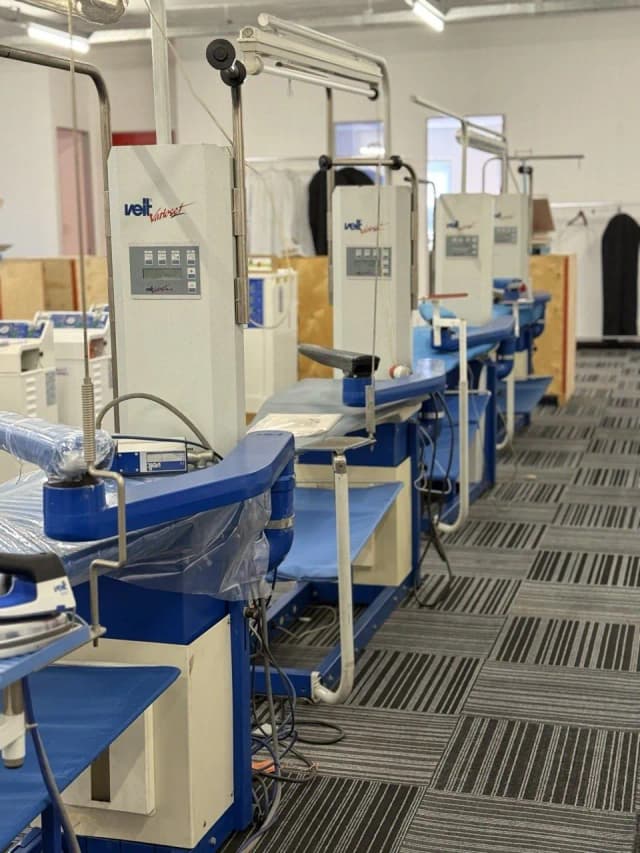
Free-standing automated finishing equipment, the garment goes onto an inflatable form (or through a tunnel), steam and warm air are injected, and the garment emerges fully finished in 30-90 seconds without an operator pressing each piece. This is the right call for commercial laundries processing 200+ garments a day, hotel laundries handling staff uniforms in volume, or garment factories with in-line finishing requirements. VEIT is the global leader; their universal form finishers and steam tunnels integrate into industrial laundry conveyor systems.
Quick rule of thumb: Under 80 garments/day → upright tank steamer. 80-200 garments/day → boiler-fed system or two upright steamers running in parallel. Over 200 garments/day → consider a form finisher to remove operator labour from the bottleneck.
Specifications That Actually Matter for Commercial Use
Manufacturer datasheets emphasise different specs depending on how each brand wants you to compare. Here are the metrics that genuinely predict long-term commercial performance, focus on these and ignore the rest.
Sustained steam output (g/min), not peak wattage
A 1,500W domestic steamer and a 1,350W commercial steamer can have wildly different actual steam output. The number to compare is grams of steam per minute (g/min) sustained over a 30-minute test, not the power-rating sticker. For commercial use, look for 45+ g/min sustained.
Heat-up time and recovery time
Heat-up time is initial, boiler from cold to operating pressure. Commercial units do this in 60-120 seconds. Recovery time is more important: after 5 minutes of heavy steaming, how quickly does the boiler regain full pressure? Cheaper machines drop noticeably as the day progresses; a quality commercial unit holds steady output for the full shift.
Water capacity and refill cycle
A 2.5-litre tank gives roughly 60-90 minutes of steaming. A 4-5 litre tank gives a full half-shift. For a busy dry cleaner, fewer refills means more garments per hour, sometimes worth a slightly larger machine for the workflow saving alone.
Certifications
For South African commercial use, look for CE (European safety), VDE or UL (electrical), and CSA. Multi-region certification signals the unit was engineered for variable mains conditions, important when you’re running off Eskom or a UPS.
Spare parts availability in South Africa
This single factor decides whether your steamer is back in service in two days or two months. The brands listed below all have local stockholding through Universe Corp, heating elements, heads, hoses, gaskets, descaling kits. For any other brand, ask the supplier the parts question before you buy.
Brand Comparison: Silver Star vs Silter vs Due Effe vs VEIT
Here are the four professional brands Universe Corp distributes for commercial customers, with our honest assessment of where each fits.
Silver Star, upright tank steamers (entry to mid-commercial)
Korean specialist for upright tank steamers. The SR-5000 (1,350W, 2.5L tank) is the day-in/day-out workhorse for small-to-mid dry cleaners; the SR-8000 (1,800W, 4.5L tank) is the larger-tank option for higher throughput shops. Both have CE/VDE/UL/CSA certification and the lowest operator learning curve in this guide. See our SR-5000 vs SR-8000 deep-dive →
Silter, boiler-fed steam ironing systems (mid to high commercial)
Italian specialist for separate-boiler steam ironing systems. Silter pairs a stainless-steel pressure boiler with a professional steam iron, a steam-gun, or a brush attachment for fabric care without water spotting. The right choice if you finish premium garments where dry steam matters (suits, wedding gowns, fine knitwear), or if your operator works through a high-volume run without wanting to refill mid-shift.
Due Effe, industrial steam irons + heated tables
Italian manufacturer of professional steam irons, heated and vacuum ironing tables, and the JOLLY range of compact industrial steamers. Due Effe is often the right call when you’re combining steaming and pressing in the same workstation, for example, a tailoring or alterations shop that needs both an iron with vacuum-table support and a steam-head for finishing.
VEIT, form finishers and steam tunnels (industrial scale)
German engineering for the industrial end of finishing, universal form finishers, shirt finishers, steam tunnels, and integrated finishing lines for commercial laundries and garment manufacturers. If your throughput pushes past 200 garments a day or you’re integrating finishing into a conveyor system, VEIT is where the conversation should start. Not the right choice for a small shop, but unbeatable at the scale it’s designed for.
| Brand | Best for | Throughput sweet-spot | Price band (ZAR) |
|---|---|---|---|
| Silver Star | Upright tank steaming for dry cleaners, hotels, retail | Up to 100 garments/day | R12,000–R25,000 |
| Silter | Boiler-fed dry-steam ironing for premium finishing | 80–250 garments/day | R18,000–R45,000 |
| Due Effe | Combined iron + vacuum table workstations | 60–200 garments/day | R15,000–R55,000 |
| VEIT | Form finishers and steam tunnels at industrial scale | 200+ garments/day | From R150,000+ |
Indicative price bands as at May 2026. Contact Universe Corp for a current quote based on your specific requirements.
Sizing the Steamer to Your Daily Throughput
The single most common buying mistake we see at Universe Corp is undersizing, operators who buy a steamer rated for 50 garments a day and then find it can’t keep up six months in. Here’s how to size correctly.
Small dry cleaner / alterations shop (under 60 garments/day)
One Silver Star SR-5000 covers it. 2.5L tank means roughly 2-3 refills per shift; sustained 1,350W steam handles wool coats, denim, and lined garments. This is the entry point for any operator opening a new shop.
Mid-volume dry cleaner / hotel laundry (60-150 garments/day)
Either two SR-5000 units running in parallel (so refills don’t stall the workflow) or a single Silver Star SR-8000 with the 4.5L tank, or a Silter boiler-fed system if you finish premium goods. Two parallel SR-5000s often costs less and gives redundancy if one needs servicing.
High-volume operation / commercial laundry (150-300+ garments/day)
This is where boiler-fed Silter systems start to dominate, and where a VEIT form finisher pays for itself by removing the operator from the steaming step entirely. A form finisher does in 60 seconds what a hand-steamer takes 3-5 minutes per garment.
Garment manufacturer / in-line finishing
Different problem entirely. You’re finishing in batch as garments come off the production line. Talk to us about VEIT shirt finishers, universal form finishers, and steam tunnels integrated with your existing conveyor.
Total Cost of Ownership: What to Budget Beyond the Sticker Price
The purchase price is only part of the lifetime cost. For a working commercial steamer over a 5-year operating life, expect:
-
Power consumption: A 1,350W steamer running 6 hours/day at intermittent duty draws roughly 15-20 kWh/week, or about R250-R350/month at current South African commercial tariffs.
-
Water and descaling: Use only distilled or properly filtered water in any boiler-based system. Descale every 60-90 days depending on local water hardness, descaling kits run R200-R400 per cycle.
-
Replacement consumables: Steam heads and hoses are wear items. Budget one replacement set every 18-24 months on heavy use.
-
Servicing: A commercial steamer should have a service check annually, element resistance, hose integrity, valve seating. Universe Corp offers service plans for distributed brands.
Add it up: roughly R5,000-R8,000 a year in operating costs on top of the initial purchase. Compared to the labour and customer cost of running a domestic steamer that fails mid-shift, the commercial unit is the cheaper option from year one.