








A hospital laundry is not sized from bed count. It is sized from its linen streams, the volume in each, and the infection-control standard the facility works to. Bed count is one input to the volume; the standard decides the machines. This is the method Universe Corp works through with a facility. The figures in it are the facility's own.
Step one: list the linen streams
Sheeting and pillowcases. Blankets. Towels. Patient gowns. Theatre linen. Staff uniforms and workwear. Curtains and soft furnishings. Each stream has its own soil, its own wash process and often its own finishing, and they are not interchangeable in the calculation. A facility that sizes on total kilograms and then discovers that theatre linen and uniforms need separate handling has sized wrong.
Step two: kilograms per day, per stream
For each stream, the daily kilograms on a peak day, not an average one. Peak is what the laundry has to clear; average is what it will do most days. The facility supplies these figures from its own linen counts. We do not estimate them from bed numbers, because the ratio varies with the kind of care, the change frequency and whether the facility outsources any stream.
Step three: the standard decides the washer
Healthcare linen is processed to a documented standard, not merely to a clean result. Where cross-contamination has to be demonstrably controlled, the equipment that the documentation stands on is a barrier washer-extractor: two independent doors on opposite sides of the drum, soiled linen in through the dirty side, processed linen out through the clean side in a separate room. Staff never cross zones. That physical separation is what RABC, the Risk Analysis and Biocontamination Control standard set out in EN 14065, asks for.
Both the Speed Queen and Girbau ranges are available in barrier configuration; the industrial washing machines page sets out the mechanism. Where a barrier machine is not used, the layout has to enforce the separation instead, and that is a design decision made before the machine is ordered.
The wash process itself has to be repeatable and evidenced: temperature, dwell and chemistry. A machine that cannot report what it did is a gap in the record. Disinfection is a chemistry and temperature question as much as a machine question, and the detergents and chemicals are specified with the machine, not after it.
Step four: capacity and machine count
The daily kilograms per stream, divided by the cycles a shift allows, gives the washer capacity and count. The Speed Queen SC Series runs 9 to 36 kg hardmount, the SY Series 18 to 36 kg softmount, and the Girbau HS Series to 110 kg; the Speed Queen vs Girbau comparison covers what each is built for. Streams that must not mix in the drum need separate machines or separate scheduling, and separate scheduling reduces the cycles available to each.
Step five: the dryer, sized against the washer
A dryer should clear the washer's load in the time the washer takes to run the next one. Undersize it and the whole line waits. Extraction speed decides most of the dryer's work: a 400G softmount extractor leaves linen substantially drier than a 100G hardmount, and that difference is dryer time and electricity on every cycle. The Speed Queen Classic Line runs from 14 to 90 kg with electric, gas or steam heating; the industrial tumble dryers page covers heating choice and the airflow a plant room has to provide.
Step six: finishing
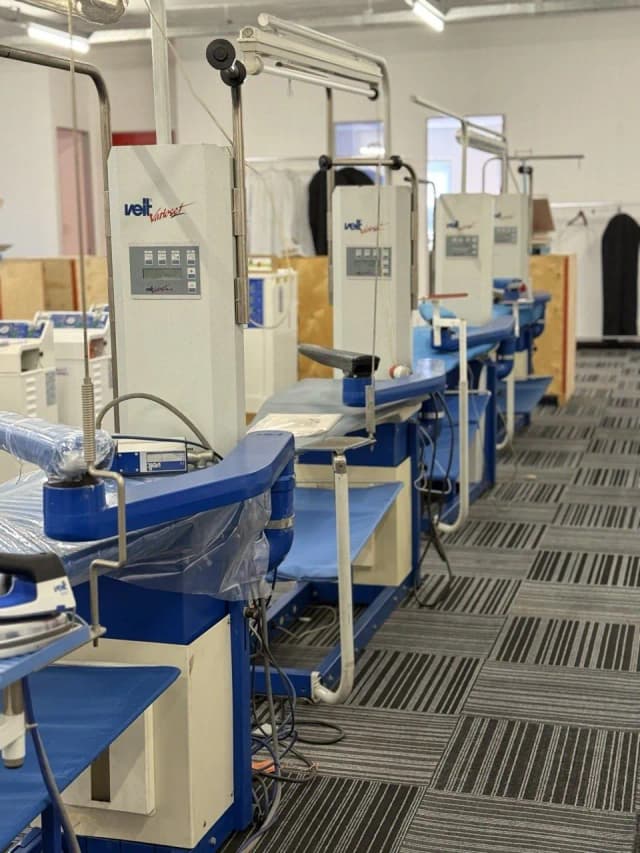
Sheets, pillowcases and table linen are finished on a flatwork ironer, a large-format ironer built for the job. Uniforms and gowns that are pressed go to a vacuum ironing table or a press. The finishing equipment page lists what each machine does. Every finishing station draws steam, which brings the boiler into the calculation.
Step seven: steam and water
Every press, ironer and steam-heated dryer is a station the boiler feeds, at its own rate, and the boiler is sized against the stations that run at once. Send the station list rather than a kilowatt figure; the industrial steam boilers page explains why. Where a boiler is used, council approval and periodic inspection under the Occupational Health and Safety Act apply. Feedwater treatment belongs in the original specification: scale is what kills a boiler, and a point-of-entry descaler is under water filtration and scale protection.
Step eight: tracking the linen
Marking and identification matter more in healthcare than almost anywhere, because losing a set is a stock problem and a traceability problem at once. Heat-seal labels, tags and barcode systems are under labelling and marking, and the RFID and barcode tracking guide covers the options.
What we do and do not do
Universe Corp specifies the equipment and the wash process, installs and commissions it, trains the operators and holds parts in Wynberg. The certification of the laundry is between the facility and its accrediting body, and we will not claim otherwise. The healthcare page sets out how the rest of the line is put together around a barrier machine.