
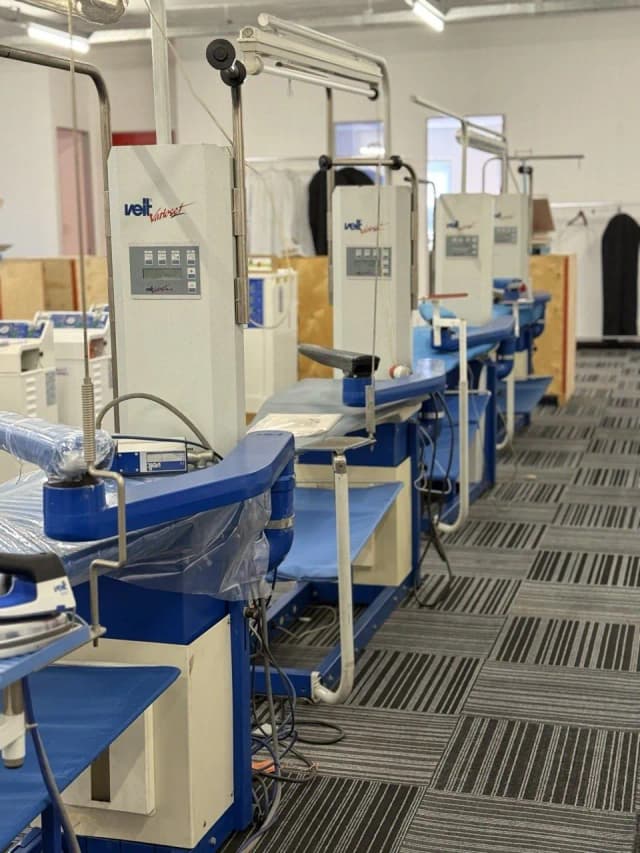









Finishing is where a laundry or dry cleaner earns its reputation. Washing and cleaning happen out of sight; the pressed, shaped, crisp garment on the hanger is what the customer actually judges. Garment finishing equipment is the machinery that produces that result at commercial speed: irons and tables, steam presses, shirt finishers, form finishers, toppers and the steam infrastructure behind them.
This guide maps the whole finishing landscape so you can see which machines belong in which operation and in what order to invest. Universe Corp has supplied finishing equipment to Southern African businesses since 1985, representing VEIT of Germany and Rotondi of Italy among Europe’s leading finishing brands, with installation, training and support countrywide.
The Finishing Equipment Family Tree
Ironing stations: iron plus vacuum table
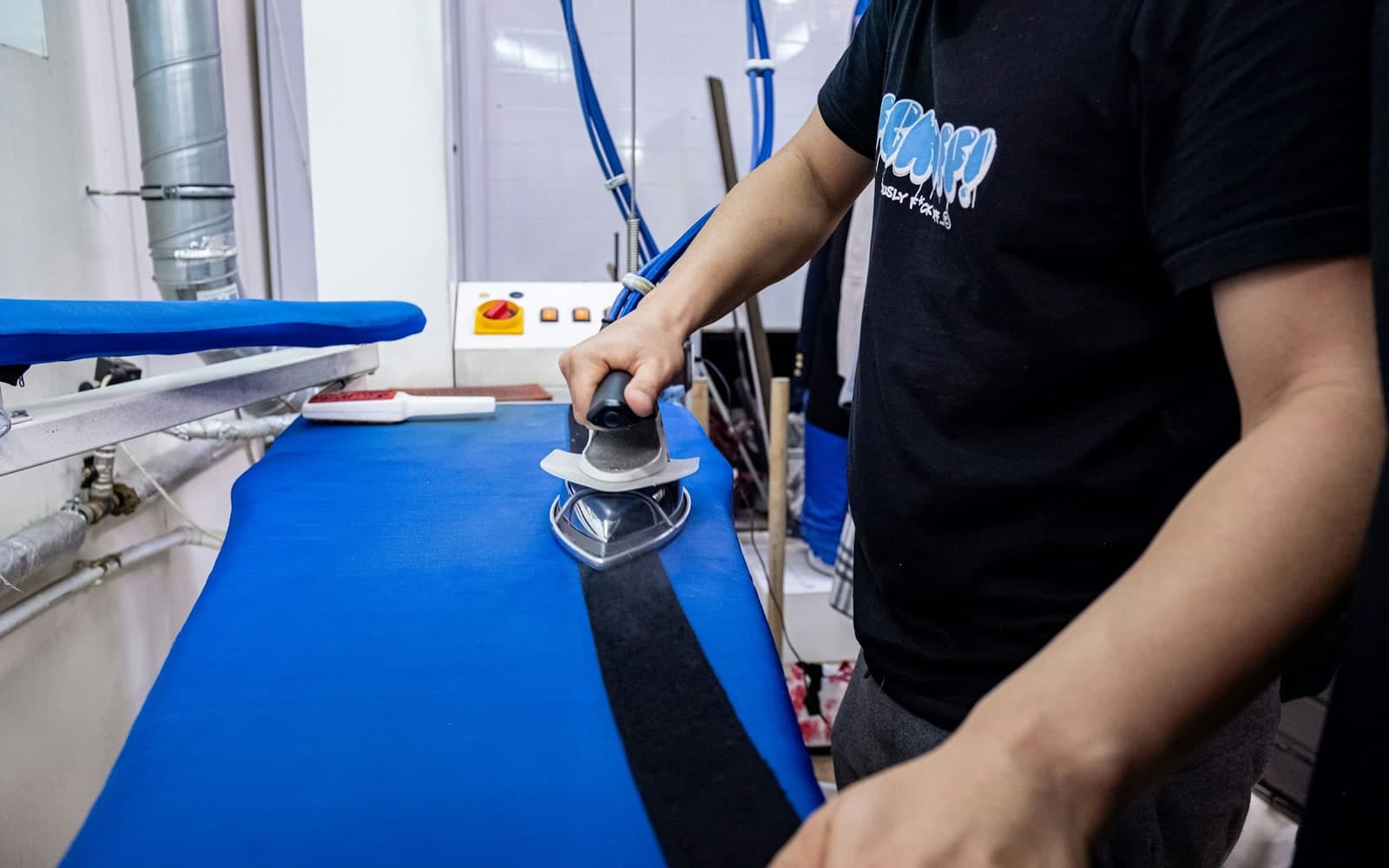
The foundation of every finishing room. A professional steam iron on a vacuum ironing table handles detail work no automated machine can: collars, cuffs, pleats, linings and awkward garments. The vacuum table holds the garment, extracts steam and dries the piece as you work, and blowing tables add air cushioning for delicate fabrics. Start here; every other machine supplements this station. See our steam iron buying guide and vacuum units range.
Steam presses
Two heated, padded bucks close on the garment, applying heat, steam and real pressure at once. Presses excel at flatwork and crease-setting: trousers, pleats, linens and heavy fabrics that steam alone cannot flatten. What an operator irons in minutes, a press does in seconds, with identical results piece after piece. Fresh press covers and padding are essential to press quality and should be replaced on schedule.
Shirt finishers
A pressed shirt is the single highest-volume item in most laundries, and shirt finishers exist because ironing shirts one by one is the bottleneck. The damp shirt goes onto a heated form, steam and hot air tension and dry the body and sleeves, and the shirt comes off needing only a touch-up at collar and cuffs. Throughput rises from a handful of shirts an hour by hand to a multiple of that per operator.
Form finishers and toppers
The same principle applied to other garment families. A form finisher (steam dummy) inflates jackets, coats and dresses with steam and air to finish them in shape without pressure shine. A trouser topper tensions and finishes trouser legs and waistbands. Together they let a dry cleaner finish suits at speed with a quality hand ironing cannot match on structured garments.
Steam infrastructure
Every serious finishing room runs on steam, so the boiler or steam generator is the heart of the operation, sized to the number of irons, presses and finishers it feeds. Undersize it and every machine downstream underperforms.
Matching Equipment to Your Operation
Two rules of thumb guide the investment sequence. First, buy the ironing station properly before automating anything: it is the quality backstop for every garment the machines cannot handle. Second, automate your highest-volume garment first, which for most laundries means shirts, and for most dry cleaners means the suit flow through a form finisher and topper.
Quality Brands Matter More in Finishing Than Anywhere Else
Finishing machines combine heat, steam, compressed air and moving parts in daily industrial use. The gap between premium European engineering and cheap imports shows up within the first year, in temperature stability, padding quality, air control and, above all, parts availability. Universe Corp represents VEIT, the German benchmark in pressing and finishing technology, and Rotondi, the Italian specialist in pressing and finishing equipment, with spares, installation and operator training provided locally. A finishing machine without a local parts and service channel is a future paperweight, whatever its brochure says.
For how finishing equipment divides the work with steamers and irons at the garment level, see our comparison of steam irons, garment steamers and presses.