






Dry cleaning is one of the more defensible service businesses you can build: demand is steady, customers are habitual, and the equipment barrier keeps casual competitors out. It is also a business where the wrong early decisions, especially on equipment and premises, are expensive to unwind. This guide walks through what dry cleaning actually involves, the equipment a plant needs, premises requirements, indicative cost thinking and the mistakes we see most often.
Universe Corp has equipped South African dry cleaners since 1985, from single-store startups to plant operations, as authorised distributor for BOWE dry cleaning machines and Europe’s leading finishing brands. This is the advice we give across the counter.
First, Understand What Dry Cleaning Is
Dry cleaning is not dry: garments are washed in a liquid solvent instead of water, inside a sealed machine that cleans, extracts and recovers the solvent in a closed loop. Solvent cleaning removes greasy soils and protects fabrics that water would shrink, distort or fade, which is why suits, formal wear, delicate fabrics and structured garments go to a dry cleaner. A dry cleaning plant therefore has two production halves: the cleaning side, built around the dry cleaning machine, and the finishing side, where cleaned garments are pressed and presented.
The Equipment a Dry Cleaning Business Needs
The dry cleaning machine
The heart of the plant, and the largest single investment. Machine capacity, solvent type and build quality determine your throughput, running costs and compliance. BOWE of Germany, which Universe Corp represents in Southern Africa, is among the world’s most respected manufacturers. Buy this machine with a local service and parts channel or do not buy it at all; see our dry cleaning machines range.
The finishing line
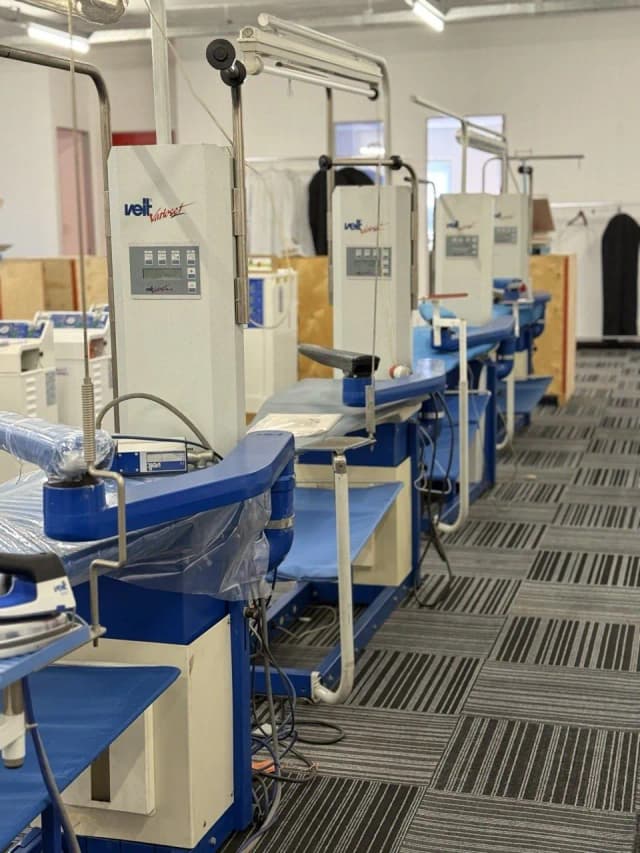
Customers judge the pressing, not the solvent. Minimum viable finishing is a professional ironing station: gravity-feed steam iron on a vacuum table, fed by a boiler. As volume grows, a form finisher for jackets, a trouser topper and a utility press multiply throughput, as covered in our garment finishing equipment guide.
Steam supply
A steam boiler sized to your irons, presses and finishers. Undersizing the boiler is a classic startup mistake that throttles every machine downstream.
Garment identification
From day one, every garment must be tracked from reception to collection. Temporary tagging systems handle the daily flow, and a heat-seal labelling station adds a profitable marking service for schools and care homes. See our garment labelling systems guide.
Supporting equipment
An upright garment steamer for delicates and quick finishing, water treatment for the boiler in hard-water areas, spotting equipment and consumables, rails, covers and packaging. The equipment checklist for a new business lists all of it in buying order.
Premises, Power and Compliance
-
Location: dry cleaning is a convenience purchase. Visibility, parking and morning-evening accessibility drive volume more than cheap rent saves money. Many operators pair a visible reception store with production on site or at a separate plant serving several receiving stores.
-
Services: three-phase power for the machine and boiler, good ventilation, water supply and drainage. Factor backup power planning into the design; load shedding is a production risk you can engineer around at setup far more cheaply than afterwards.
-
Compliance: solvent handling, waste disposal and workplace safety carry regulatory requirements, and municipal zoning must permit the use. Confirm current requirements with your municipality and industry body before signing a lease.
Costs: How to Think About the Investment
Exact figures depend on machine capacity, brand and the rand’s exchange rate, so treat any static number you read online with suspicion. The structure of the investment is stable, though: the dry cleaning machine is the largest item, followed by the boiler and finishing line, then reception fit-out, identification systems and working capital for consumables and marketing. Two principles protect you. First, buy the finishing line properly rather than maximally: one excellent ironing station beats three mediocre machines. Second, price equipment as cost per year of service, favouring machines with local parts and service; the cheapest machine with no support channel is the most expensive machine you can buy. Request current equipment pricing to build a real budget.
For the laundry side of the industry, our companion guide on how to start a laundry business in South Africa covers the washing-based model.
The Five Most Common Startup Mistakes
-
Buying the dry cleaning machine on price alone, discovering later that parts and technicians do not exist locally.
-
Undersizing the boiler, throttling every press and iron in the plant.
-
Treating finishing as an afterthought, then losing customers over pressing quality the machine side cannot fix.
-
No garment tracking discipline from day one, paying for it in lost garments and claims.
-
Skipping operator training, running premium machines at a fraction of their capability. Universe Corp includes installation, commissioning and training with equipment for exactly this reason.