







Every new laundry or dry cleaning business faces the same planning problem: a long shopping list, a finite budget, and no clear guidance on what is essential now versus what can wait for revenue. This checklist solves that. It lists every equipment category a textile care business needs, in sensible buying order, with what each item does and the mistake to avoid when buying it.
Universe Corp has equipped South African laundry and dry cleaning startups since 1985. This is the checklist we walk new owners through, and every category links to the relevant equipment range.
Tier 1: The Production Core (Cannot Open Without)
Washing or cleaning capacity
-
Laundry route: commercial-grade industrial washing machines and tumble dryers. Domestic machines in commercial service fail fast and void their warranties; capacity-rated commercial machines like Speed Queen are the entry standard.
-
Dry cleaning route: the dry cleaning machine is the plant’s heart and largest investment. Buy only with a local parts and service channel; our guide to starting a dry cleaning business covers the decision in depth.
Mistake to avoid: sizing machines on opening-week volume instead of month-twelve volume. Upgrading capacity later costs more than buying one size up now.
Steam supply
A steam boiler or generator sized to every iron, press and finisher it will feed, with headroom. For small operations, semi-industrial boilers with ironing boards offer an affordable entry point.
Mistake to avoid: undersizing the boiler. Every steam machine downstream underperforms, and diagnosing it later always starts with an awkward conversation about the boiler.
The finishing station
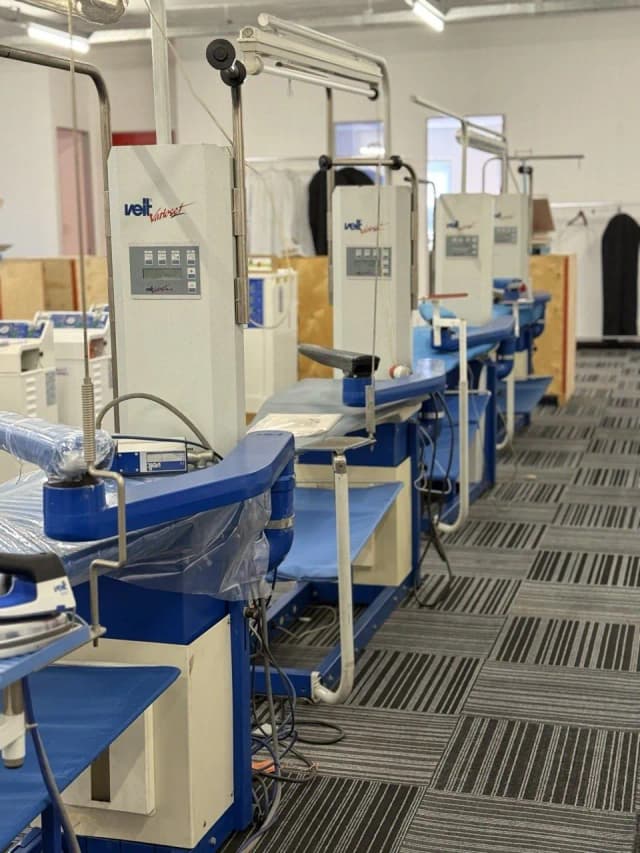
Minimum one professional ironing station: a gravity-feed or boiler-fed steam iron on a vacuum ironing table. Customers judge your pressing, not your washing.
Mistake to avoid: treating finishing as an afterthought and budgeting it last. One excellent station beats three mediocre ones.
Tier 2: Quality and Speed Multipliers (First Growth Purchases)
Garment steamer
An upright professional steamer such as the Silver Star SR-5000 or SR-8000 handles delicates safely and clears rack finishing at speed, beside the iron rather than instead of it.
Garment identification
Temporary tagging for daily order tracking, and a heat-seal labelling station for permanent marking, which also opens a profitable school and care-home labelling service. Universe Corp supplies Thermopatch labelling systems as authorised distributor; see our garment labelling guide.
Water treatment
South African municipal and borehole water is often hard, and scale is the silent killer of boilers, irons and steamers. Water filtration and softening protects every machine on this list for a fraction of one repair bill.
Finishing automation
When volume justifies it: a shirt finisher if shirts are your volume item, then form finishers, toppers and presses per our finishing equipment guide.
Tier 3: Consumables and Support (Ongoing)
-
Detergents and chemicals: professional detergents and cleaning chemicals, including BUFA of Germany, matched to your processes.
-
Spare parts and wear items: spares and consumables for irons, steamers and presses, plus press covers and padding replaced on schedule.
-
Packaging and presentation: covers, hangers, rails and reception materials.
The Checklist at a Glance
Three Buying Principles That Protect Your Capital
-
Buy cost per year, not sticker price. A supported machine that runs a decade beats a cheap one replaced in eighteen months, every time.
-
Insist on local parts and service. Every machine on this list is a production asset; downtime is lost revenue. Universe Corp holds parts in Johannesburg and services countrywide, with installation, commissioning and operator training included on equipment we supply.
-
Leave headroom for growth. Boiler capacity, floor layout and electrical supply should anticipate the machines you will add in year two, not just the ones arriving this month.